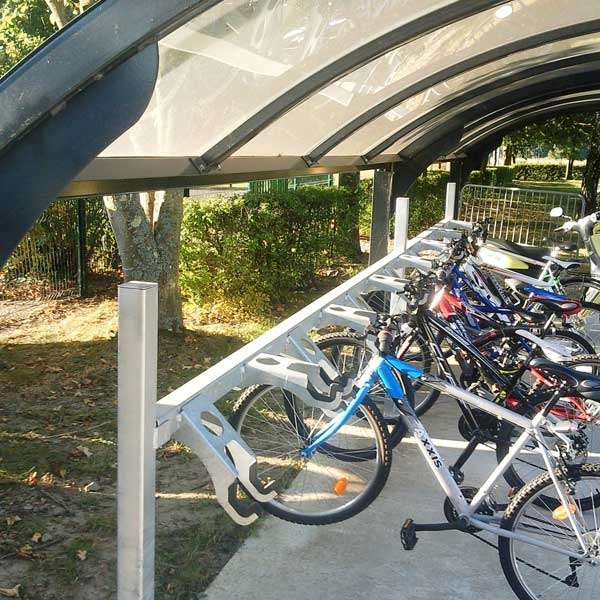
In my car-centric city (southeast USA, population ~125k) when I visit private property with no bicycle parking, I try to find the owner and offer to install one of these just for the cost of materials. The idea being, they can put in another one when they see more than one customer on a bicycle at the same time. It's very cheap, less than 100 bucks typically as I have the requisite tools in my garage to make them from scratch out of metal tubing. There's a variety of materials, finishing, and mounting options the property owner can choose from. I've done about a dozen of them, it makes biking around my city much more pleasant and my day is brighter when I see someone else using one.
Many cities will install these in front of businesses for free! The business owner just has to submit an application, and local bike lobby is paid to install it!
If I was an owner, I'd have a lot of problems with this just because I'd be worried there'd be some regulation I was violating that would get me fined.
If it's on the owner's property, it's probably kosher. Many cities have rules about the proximity of bike racks/stands to fire hydrants, parking meters, etc., but those generally concern public sidewalks.
I say probably because, knowing this country, I am positive someone can find a municipality that bans storeowners from putting bike stands on their property.
So much for search engine NLP. I couldn't find anything other than pages with Sheffield stands for sale using the term "tapping bar". Had to read the tweet[1] to get the term "tapping rail", which successfully turns up civil engineering documents.
Maybe creating a Wikidata item with both terms as labels would give search engines a better idea.
For bike owners: a wheel lock [1] is not very high security but it's usually enough for a 3-minutes stop and it's extremely fast to lock and unlock, unlike chains.
I have used these (preinstalled or installed them myself) on several bicycles for years now, and none of them have been stolen yet. Mind you, that might also have something to do with the bicycles not looking very desirable (while being technically sound of course). For some added safety, there is also a version where you can attach a chain or cable which you can thread around a bike stand (https://www.amazon.de/Abus-11263-8-Fahrradschloss-St4850-sch...)
This is really cool. I’m sure this helps you develop a relationship with the business owners, too, which I would think helps foster more of a sense of community for everyone. Very neat.
To be appropriately secure, these really need installing in concrete as shown in the initial tweet. Still, better to have one less secure sheffield installed than zero.
For the simplest case yes, a way of bending big pipe and some way to make two big holes in the ground to then cement the thing in. (Or similar) But it quickly gets complicated - making smaller holes in concrete type surfaces is easier, less intrusive, less permanent than making bigger holes, which can lead to the flange method, but then you need some way to make or buy flanges, and then stick them onto the pipe. I make my own flanges out of plate and weld them on but you could go with threaded flanges, I think Home Depot (or similar) can thread high diameter pipe for you.
You can also skip the pipe bender by mitering two pipes together with a welder or doing like a pie cut thing. I do that kind of thing for pipe that's harder to bend - bend it to 45deg, miter cut and weld to 90 is a common technique for me. If you look up how DIY car exhausts are fabricated there's a lot of relevant tricks there. With a grinder and some elbow grease you can make it look like it was never welded.
For the finishing touch it's nice to have a friend with a galvanizing and powder coating shop :)
I have a pipe bender that looks kinda like this but sideways and yellow and mounted on a tripod. I bought it from a guy who does water-suppression system installs for warehouses.
The 10/12/14/16-ton pipe benders you get from China go up to 3" nominal (3.5" OD) depending on which one you get. The smallest cheapest ones do 2" nominal pipe (2.5" OD) which is fine for a bike rack.
In general, the author is right, and the simple design is by far the best. But the classic Sheffield stand with a circular cross section can be easily cut with a pipe cutter. Contrary to an angle grinder, a pipe cutter doesn't make any noise.
Thus, the design has been improved by making it solid instead of hollow and giving it a rectangular cross section, like [1].
I used to hate the improved design because it's obviously less friendly to a nice bike's paint job until I learned the reasoning behind it.
At least in the UK, many of the sheffield stands are made of fairly thick-walled steel and 50mm outer diameter. It would take quite a bit of time and effort to cut one with any hand tool. A solid design would be complete overkill and make them really expensive.
That said, some do pop every now and then up that seem to be quite flimsy, often having been bent down to a 45 deg angle by a careless motorist.
These[0] used to be rather common in the Netherlands And are actually pretty much fine on the wheel bending front if there's enough bicycles parked. You'll just stick your bicycle at the end of a group of bicycles and it'll be prevented from falling over by its neighbors. Still sometimes seen in lowish traffic areas where theft is not very likely.
These days you'll more often see these[1] which are a bunch more dense because of the vertical staggering, and you'll note the convenient attachment point for a chain lock. Less ideal with respect to brake and shifter cables, but there's a reason the preferred style of city bike has no gears and a kick brake.
At big places you'll often see these[2] which are incredibly dense. Bicycles on the top rows can be accessed by sliding the rail out and tilting it down. No real provision for a chain lock, but if you're parking at a train station you're already not caring too much about theft. Never mind that there being so many bicycles means that having even a halfway decent lock means any would-be-thief is just going to pick from one of the thousands of other slightly less securely locked bicycles.
Hope that gives some insight on how it's done in the netherlands.
That seems like an entirely theoretical risk. I've never seen a sheffield stand cut, or actually even any easier-to-cut stands cut. I've seen plenty of bike locks cut or attempted to be cut though.
I think it's not as easy as you think, and perhaps more importantly passers by are much more likely to challenge you if you're cutting a bike stand in half!
Lucky you! I've seen a few Sheffield type stands cut through, and the cut definitely looked like it had been done with a pipe cutter, not with an angle grinder. I think it's well possible that the stands are made from softer steel where I live.
It... doesn't actually matter much; if a bike thief wants your bike, they'll get it. Most bike locks are to avoid them being picked up quickly.
If you have an expensive bike, insure it for theft and lock it up in a way that ensures someone has to break something to get your bike. That should cover your bases.
The lithium battery revolution has made “someone has to break something to get your bike” an impossible goal. I occasionally see Kryptonite U locks with neat angle grinder cuts through the end hanging from bike racks around Brooklyn. The only thing that would really work is ABUS’s aluminum-shrouded U lock which will make an attacker go through a few cutoff wheels before reaching the steel hasp. But it weighs 30lb.
Really the thing saving you is that jerks with angle grinders are pretty rare, and a U lock will stop any opportunist.
I doubt it, bike thieves will just use a battery angle grinder with a cutting wheel on your bike lock, and everyone will absolutely ignore them doing it in the middle of the day.
They're much cheaper than an angle grinder, and fit in your pocket. I've used one to cut through the barrel of a d-lock with ease. I don't buy d-locks with cylindrical barrels any more. I learned this trick when thieves stole my friends bike this way :-(
Yes, this is the tool I was talking about. For a d-lock (aka u-lock), you'd need a quite large lock with a lot of space between the crossbar and the bike for a pipe cutter to work. The risk does exist nonetheless, which I wasn't aware of before. Thanks for pointing that out!
What are bystanders going to do? If you call the cops about someone stealing a bike they'll show up three hours later and shrug, if they show up at all.
If I were doing something undeniably thefty, like leaving a car on blocks or taking an angle grinder to a bike lock I'd expect to be confronted and maybe given a good beating depending on the details of the situation.
I live in the kind of city that most of HN would sneer at and make some quip about it being a rusting post-industrial wasteland of poverty. I guess we're not very enlightened but my Amazon packages don't go missing from my doorstep so I don't complain.
Def not in Japan, bike theft is pretty rare altogether. Just wish they'd stop using the front wheel bender racks, but everyone seems fine with them unfortunately.
It just has to be strong enough to require marginally more effort to cut than a typical high security bike lock. A good planner will anyway choose a design that's significantly thicker to avoid the replacement cost when someone does try to cut it.
Sorry, I'm not a native English speaker. What I meant was that the newer, improved design doesn't use steel pipes any more. Instead, solid and rectangular shaped steel is used that can't be cut with a pipe cutter any more. The page behind the link should make it clear. You can filter it by "Eckig" ("rectangular") to see the ones I mean.
For most bike "racks" here in NL it seems like the primary purpose is not security, but just having somewhere to lean bikes against and give people a sensible place to park their bikes (as opposed to "in a huge pile")
Most people don't bother physically locking their regular city bikes to anything (only using a ring lock on the bike itself), primarily cheap beater bikes but also there's a guy in my street with a €2000 Van Moof e-bike that I think is just leaning against his front wall.
In the UK you absolutely need security - London especially anything not held down will be stolen quickly. Battery powered jigsaws to go through locks and chains, bikes stripped of components, etc. Its a whole different world from the safety of NL
Granted some of this is because of a culture of more expensive bikes but still if you used a beater bike it wouldnt be safe either
Honestly, that was my initial impression seeing this tweet storm. Living first in the Netherlands and then Japan, it seems like being so fussy about bike stands is wholly unnecessary.
Agreed as a Japan resident but having been a SF resident even crappy bikes would be stolen in seconds for sure. So it depends on the place you live in.
Cambridge too, which I think is interesting because it's otherwise often compared to NL et al. for density, relative friendliness, prevalence of attached buggies & wheelbarrows, etc.
Where I live in the US, bicycle theft is rampant. It's in the sweet spot of "sells easily for a decent chunk of change, but cheap enough that the police won't investigate."
No. You absolutely need to get a theft insurance for your bicycle.
All bicycles parked outside can be stolen. Any "security" measures you may take just tip the risk-reward calculation of the bicycle thief in your favour, and against the folk parked next to you who didn't know better.
Fyi, most bike insurances in germany will require you to have your bike locked up against a solid (i.e., non-movable) object with some even putting requirements on locks (shackle diameter, ...). I don't know how much those rules are enforced though I imagine for some claims they may be challenged.
In the Netherlands you are only required to (a) use a ring lock and a chain with a rating of at least two stars [1], (b) deliver 2 + 2 keys to prove that you had actually locked your bicycle (keys can't be removed without locking).
The "lock against a solid" requirement in Germany is unreasonable to fishy. Can one really prove or disprove that?
It might later pay you back what you spent monetarily, but the inconvenience is not merely financial. It seems crazy that I'm having to argue that locks and insurance are not interchangeable.
Are you suggesting not to lock up your bike in London? That's insane - you will get your bike stolen every time you leave it somewhere for more than an hour - your insurance is not going to be happy with you after a short while.
Not sure it's that easy. My contents insurance includes bikes but there are some weird clauses and this is in line with what I have seen with standalone theft insurance. I'm not hopeful they'll actually pay unless you maybe hand in a photo of your locked bike with 2 "good" locks.
I gave a police crime number (acquired online) and the receipt for the approved lock, and the claim was quickly approved. I think I chose the insurance company recommended by the London Cycling Campaign.
No one locks their bikes in Japan, either. According to Wikipedia this is thanks to "strong policing and general public disregard for stolen items." I can certainly say I've never heard of a US police department doing anything proactive in response to a reported bike theft.
In Japan every bike is officially registered and has a sticker with a number (think of it as a license number that has to be read closely). Foreigners are stopped by the police fairly often in Japan to check their bike licenses according to reports in /r/japanlife.
When I lived in Minneapolis, police encouraged a bike registry; they'd send you this serial number sticker plate that affixed to the frame rather well.
No doubt many flaws with that, I don't know if it helped. But I got a sticker.
(3M home town... they are good at sticking things together.)
People lock their bikes... just using the ring lock in general. If only because you need to put the key in to unlock the ring lock (and ride the bike) and then when you're somewhere if you don't lock it your key is just on the bike.
Of course it's a tiny ring lock. It's to stop unmotivated people and also people just taking the wrong bike. But works well enough.
Probably not 100% but "no one locks their bike" is incorrect.
You also have to to do some paperwork for buying a bike. I assume you have to transfer ownership when selling, so stolen bikes probably cannot really be sold on the open market.
Out of sheer ignorance: what are the implications of not having the proper paperwork? Do Japan's street policemen take note of suspicious looking bikes and follow up with their owners?
The police stop bicycles and ask who it's registered to. They can look up the registered owner from the registration sticker. If you stole the bike then you don't know the name of who it's registered to. In general there's no requirement to carry ID (apart from for foreign nationals) so police can't rely on cross checking against the ID people are carrying. Also, bicycles might be registered to a friend or a family member, so knowing the registered name and providing an explanation should be enough.
If you have no idea about who the bicycle is registered to then the police will likely make further investigations.
I have been stopped when driving suspiciously at night. I do not know what exactly constitutes suspicious, but the main thing they do is check whether your bike paperwork is in order, and (as a foreigner) that your residence card is valid.
in japan bikes are stolen once in a while by drunk salarymen who dont want to wamk to go back home. so not 100% safe but fairly safe. also all bikes have a registration number so you eventually find them.
Vanmoof owner - it doesn’t automatically lock when you open the kick stand. There’s a ‘pin’ in the back wheel that you can just tap with your shoe to engage the lock. https://youtu.be/BpeRUGgw8JQ
I disable the Bluetooth proximity unlock - I often lock and leave it when I’m staying nearby (outsiding seating at a pub, for example) and I don’t trust that it’ll stay locked if I’m still within a relatively close distance.
Still, if I had one of those I wouldn’t leave it just on the street!
I thought about buying one but figured it was a bit much money for something I didn’t particularly need and would be fairly vulnerable to getting nicked, even with the security features. And I think the Bike Hunters thing where they retrieve a stolen bike for you is only for up to 3 years now, which is not really great, since you want to own the bike for much longer at that price.
Those frame/ring locks are no joke. We had to have one cut off of one of our bikes after losing the keys.[0] It took the guy longer than I expected with an angle grinder, made a lot of noise, sparks flying, etc.
Swapfiets rental bikes have become popular in Berlin. They have a frame lock with an integrated chain. But even if you don't use the chain, what exactly is the theft scenario? The bikes are rather heavy—which I guess is intentional. Someone highly motivated could lift the bike into a van, drive home, and then worry about cutting off the lock. It just seems a bit far-fetched.
> It took the guy longer than I expected with an angle grinder, made a lot of noise, sparks flying, etc.
Your guy was probably being very careful not to damage your bike. With the right tool, even top-quality locks with hardened boron-carbide shackles can be cut in seconds: https://youtu.be/cbYVmRNzGLc?t=368
> Someone highly motivated could lift the bike into a van, drive home, and then worry about cutting off the lock. It just seems a bit far-fetched.
One mode of bike theft in the UK is: A white van pulls up to the university/train station cycle racks, men with bolt cutters grab as many as they can in 3 minutes or so, then drive off.
As they're going for volume rather than quality, the bikes with the worst locks are the first to go.
I got my keys stuck in the lock of an old bike and had to angle grind a similar lock off too - massive pain indeed!
>Swapfiets rental bikes have become popular in Berlin
Same here in NL where they originated, in many cities a good 1/3rd if all the bikes you see (and that’s a lot of bikes) are a Swapfiets. Not too expensive, reliable, and less likely to get stolen than an average bike (good luck selling a Swapfiets inside NL, whereas other stolen bikes are much easier to offload for a few euros to drunk people late at night)
The lower the income disparity, the lower the theft crime. In places with high inequality like London, SF, New York, Rio de Janeiro, Paris etc, even beater bikes will have their locks sawn through.
And if you do want to lock your bike to something immovable, the standard seems to be a chain that locks into the ring lock, with a loop on the end- which gives you a lot more flexibility than a D-lock.
The other factor, though, is that standard Dutch city bikes are not designed to be easily dismantled. If you have quick release wheels, you want to be able to lock the front wheel as well as the frame (and ideally also the rear wheel).
I was under the impression that bikes are stolen all the time in Netherlands. There was even a joke that if you bike gets stolen, just steal another one.
I'm a bit of a cycling enthusiast and have lived in wonderful Sheffield. Yet I've never heard about this being called "Sheffield stand". Very excited to learn :)
>Also they used to make bike racks out of wood? Sick (?!)
That photo is relatively recent (2006), and it's quite likely that that bike rack is not very old. It appears to be on the grounds of a hotel estate where locking would be unnecessary and a rural aesthetic is key.
There's an American firm called Forms+Surfaces that has a whole catalog full of terrible, weird bike racks. They must have a lot of mindshare among architects apparently because their junk keeps popping up all over California. Nobody who has ever used a bicycle would choose them but they keep showing up anyway. Here's a fun tweet where local well-known cyclist rips them out of the pavement with his bare hands.
> Nobody who has ever used a bicycle would choose them but they keep showing up anyway.
It's probably a safe bet that, in many municipalities, the city planners see cyclists as a nuisance and are solely interested in doing what (they think) will shut them up. They also might see normal looking bike racks as an eyesore, hence sloppy installations combined with useless designs.
The clamp for the vertical seat bar is probably what limits this to conventional framed bicycles, but the U-ring welded below is very useful for attaching the lock as I did on the photograph. The big benefit of this one is that the clamp can be closed, and that your bicycle is then essentially storm-proof (I would guess for at least one Beaufort more than the Sheffield staple).
Those are probably fine for the Netherlands where the vast majority of bikes are city-bikes with stands. They don't offer much leaning support or multiple points of contact with the frame though, so unlikely to get the approval of the author of that article.
While the overall point of simple racks being better definitely stands, the premise that a bike needs two locks is just silly and impractical. Get wheel locks for your bikes - pinhead, hexlox (my favorite), etc. If your wheels are secured to the frame you just need to lock the frame with one lock/chain.
Takes way less time to park and you dont need to lug multiple 5lb locks (unfortunately thats how heavy secure locks actually are).
Pitlock are nice. The day I lost my Pinhead key and opened one with a flathead and a hammer in less than a minute was a little sobering. They’re still better than a quick release.
For sure, nothing is 100% secure (and even with multiple U-locks an angle grinder will win out after a while). I've had a good experience with hexlox so far - they are super hard to remove without a key. Haven't had any theft issues in multiple years of parking around San Francisco.
With wheel locks + 2 D locks you can get around the problem of the bike being used as a lever to break a single D lock. It also means thieves are less likely to screw with your bike trying to take the wheels off.
Well, I'd say that two locks are nice to have, if not entirely necessary. You can quickly use just the ring lock if you're hopping in and out of a store, and get out the larger one to lock your frame when you're storing your bike for a longer period.
It makes me think that we ought to retire the phrase "reinvent the wheel". There's lots of different kinds of wheels and it doesn't seem crazy that you would need to make a new kind. And when people do make new kinds of wheel, they generally meet some minimum bar of worthiness (rather than being say, square).
But I've never seen any improvement to the classic Sheffield stand, save possibly for the sub-variety with the extra bar underneath. Yet industrial designers insist on inflicting their patently inferior "innovations" onto long-suffering cyclists. Especially irksome when it happens in my own city of ... Sheffield! So maybe we should say "reinvent the Sheffield stand" :)
I like the broad range of this discussion between "I never have to lock my bike" and "Whatever you try, your bike will get stolen or dismantled within minutes".
While I'd like to live in a society without theft, I'm at least glad that where I live, I can leave my bike attached to some immovable object with a u-lock for a few hours and have a good chance of returning to it still being there with nothing missing.
Don't try this in San Francisco or Oakland (or anywhere in the Bay Area really). That is if you still have a bike to lock and don't get robbed of it at gunpoint.
Slightly more complex design, but easy to lock, easy to park, bike doesn't fall over, doesn't damage the paint on your frame, fairly compact if you have multiple bikes.
They're pretty ubiquitous where I live in the Netherlands; although some stores have really crappy "wheel-only" stands like in the thread.
It's nice to see they improved those by adding the plastic guard! I've got a bike with a really scuffed up fork on one side from using the old version without the guard for a few years.
Yes please! I feel "if it ain't broke, don't fix it" doesn’t capture it in a meaningful way.
I think this is more of a mental and organizational phenomenon than one guy attacking a working machine with a spanner.
A simple lack of resourcing and time pressure may be part of it, but it may have componenents of a kind of willful ignorance of prior art and complexities of the world, even ego driven, self serving and arrogant attitudes.
Perhaps it is related to the famous NIH-syndrome in software, but clearly different too. In software I think this manifests as continuous churn of features and UI elements as well as negligence of usability and technical aspects.
Praise indeed! I don't even try to park my bike at those "spokebreaker" low stands that you put your wheel into, they might as well not exist. Those are the stands that people who don't use a bike think bikers want. I didn't know this inverted U design was called a "Sheffield stand", but this works very well.
I don't remember seeing any here. Usually they're the crappy small stands where you slot the front wheel of the bike in. You can either only lock that front wheel to the stand or lock a wheel to the frame of the bike. Neither tactic is really secure though.
Bike theft seems like a problem that could be solved, or at least beaten down a lot. Super easy to attach tracking devices and monitor remotely, then just go around and arrest the thieves. There could hardly be an easier enforcement activity. Why is this not done when it seems like bike theft is at an epidemic level?
I recently reported a bike theft to the police in the UK. A few days later I received an email from someone who "screens" incoming crimes. It said "I cannot send the matter for further investigation as the value of the item stolen falls below our threshold to investigate". They didn't even check if there was CCTV coverage in the area.
I'm guessing that the bike thieves in this area are well aware of the value of this threshold and operate accordingly.
It feels like I'm living in a Discworld novel where petty crime is "designed in" to society. There's a mutual unwritten agreement that the thieves can do what they like, as long as they stick to lower-value items. If you're too poor to afford a replacement, tough luck. Even my home contents insurance was pointless, as the excess was greater than the bike's value.
You'd think so, yes. In Scotland we have a similar problem with motorcycle theft. And lots of motorbikes have trackers on them. Anecdotally * , though, even providing the address that a stolen tracker is reporting isn't enough for the police to investigate. The thought seems to be that the police are simply chronically underfunded, so they're prioritising whatever their internal targets are - presumably violent crime incidents.
Obviously this will vary hugely by region and police force. Some of them probably would be happy having easy cases handed to them on a plate.
* Very anecdotally! I don't have any stats on this, and the anecdotes come from a fellow biker who is part of an anti motorbike theft campaign group, so take with the appropriate number of grains of salt.
Bike thieves can be quite professional and experienced, and are likely to figure out common placement points for trackers. Not to mention that they will try to offload the bike quickly anyway, so you have a limited window within which to catch them. And even if you do catch the thief, you'd likely need further evidence to achieve a conviction.
How was the BIKE_VALUE / LOCK_SECURITY ratio, compared to the surrounding bikes? I always try to achieve the lowest score at the corner where I lock my bike and haven't had a bike stolen for a while.
This really is the key. Make it not worth the effort to go for your bike. Your A->B bike needs to be just capable enough to get you from A to B. Have a secondary cool bike for racing / weekends, if you're into biking.
My current commuter bike that I got after having one stolen is a beater, and the lock that's on it cost me more than the bike. Sure, it's not the greatest to ride, but I can leave it locked to the closest lamp post next to wherever I need to go, and not worry a single bit.
Also, I like to think that the big, shiny registration sticker helps persuade would be thieves not to bother. Where I live, bike registration costs just couple EUR, but judging from the absence of stickers in bike racks, hardly anyone does it.
I 100% agree. I have never found a bike stand design as good as the simple staple.
One particularly annoying thing is stands designed to hold a larger number of bikes, often by lifting bikes and hanging them or something equally annoying.
They all end up putting the bikes way too close so in practice people only use every other space and you fit even fewer bikes in.
In Indiana the types I see the most are the wave and what wikipedia calls the ladder style. I have never figures out how I'm supposed to use these when my wheels have quick release levers on them.
> On a similar theme, what about one unit you install and it holds lots of bikes?
> Not bad, but still not good enough imo
If that's your idea of "lots of bikes" (see the picture), something is very wrong.
Go to a grocery store in Shanghai, where people regularly use bikes, and there will be a fenced-off bike parking area with no stands of any kind. That's how you hold lots of bikes. The stand is a way to say "we don't expect people to use bicycles, but doesn't our stand look cool?".
Sadly, no amount of locking points provides sufficient protection against an experienced thief. In London, I've seen some of these Sheffield stands cut with an angle grinder.
It doesn't have to be perfect; just good enough. You don't have to lock up perfectly, just better than the bikes around you. And carry insurance and be prepared to replace your bicycle. Or just ride beaters.
I remind myself that taking transit costs $1200/year. That's what the poor people who can't afford a nice bike do.
I don't come anywhere close to having a $1200 worth of bike stolen every year (I'm 45 and have had 7 bikes stolen in my life of commuting by bicycle).
I just lock the frame to whatever with a U-lock.
Once I had my seat stolen, and once someone made off with my pedals, and again, that isn't enough to warrant threading cables through all my components every time I lock up.
Yup, I ride an old clunker, use a padlock and chain, and try to park next to a nicer bike with a cable lock. You need to have a really good eye for bikes to notice that my ugly bike is actually a finely tuned machine.
It lets two fit in next to each other by raising the wheel of one, and the wheel locks means it just slots in so nicely. Plus a raised part for the lock
No, you can see the mini-Sheffield protruding up between each wheel slot, and you can see a bike's frame locked to it. Hard to see in this picture but it's there.
Can't lock anything but the front wheel. And it only works for classic bike geometries, so not the more expensive cargo bikes people use as car replacements.
Simple rule of thumb for me is: if I contemplate having to lock the wheels of the bike, or bring the saddle with me so it doesn’t get stolen, then I’m not leaving my bike there. I bring my other bike that costs less than a wheel of my expensive bike instead
. Or I just walk. If I’d lose a wheel in even several years of daily biking I’d probably never bike there again.
These stands are definitely my favourites. But I use a kryptonite fuhgeddaboudit d-lock and have come across some of different thicknesses which means I have to work the angles a bit if I want to lock both the wheel and frame at the same time as the d lock is quite small. It's not always possible.
One thing that I think is commonly missed is that the entire rack isn't cleaned out at once usually. You don't need to have flawless security that it'd take a jackhammer to remove. You just need to have better security than the guy next to you.
The images don't load for me on desktop Firefox, but I can see them when I view the thread on Twitter. They seem to be blocked on Thread Reader because they're classified by Firefox as "Social Tracking."
I have never seen a Sheffield stand where I live, but far better than what we have. The only way to lock a bike to the ones here is to take up 5 or 6 lock points since these are designed only to lock your wheel to them. Have a ulock ? Find a sign.
Not sure what kind of racks you have but for some back-in parking might be easier than front-in. I try to lock one of the back tubes and wheel if possible.
I'm also a fan of the Sheldon Brown lockup strategy[1]. There's also a modified version that may be more secure[2].
I too use this Sheldon Brown style but, because my main NYC commute bicycle has quick release front and back, I pop off my front wheel and position it adjacent to the rear one so the u-lock can go around both as well as the the stand (which is more than likely a parking sign post). Takes 5 seconds, saves me carrying a second lock, and no wheels stolen in 15 years of Manhattan and Brooklyn cycling!
You really know you are dealing with a serious bike enthusiast when you see a DIY Sheffield stand installation in the front garden. Many such cases in Oxford and Bristol ofc...
That can be made somewhat more secure by unscrewing them and inserting an appropriate epoxy before putting the screws back. Not as good as a proper fixing, but far better than losing bikes to everyone with a spanner.
Depends on the prevalence of frame locks in your city. If people use simple frame locks a lot, get stands with a dangling cable or chain that can attach to the frame lock.
The fact that the poster knew the proper name for one and only one style of bike stand makes it seem to me that they started with a particular conclusion in mind and worked their way backwards to fit it.
Note: The twitter OP has put the #/n indicator in-between the caption and the photo. Which makes sense on Twitter, but when threadreader strips out the formatting it makes it look like the captions line up with the wrong image.
Captions precede the corresponding images in this thread.
But... Twitter is unreadable! I get all these weird popups and it requires enormous amounts of effort just to follow the thread.
We probably can't fix Twitter. Would it be possible to reconsider the guidelines to allow for alternative views of websites that have absolutely atrocious usability?
Some people feel the way you do and some people feel the opposite way. It's clear that no solution will satisfy everyone, so it's best to stick with the original source rule and then have links to alternatives in the comments.
Yup - certainly understandable! but best to link to the alternatives from the comments.
There are a bunch of reasons for this but the main one is that it's important for the domain name beside the title to display the original source of the article. Also, readers are divided on which UI they prefer, so there's no pleasing everybody.
I don't understand why many of the stands he calls useless are useless. Sure most of them are less economical but as long as there's a loop of metal anchored to the ground how is it useless?
They don't work for many bicycle geometries[1]. Small vs large frames, small vs large wheels, wide vs narrow tyres, tricycles, tandem bikes, cargo bikes, recumbent bikes, hand-cranked bikes etc. Also if they are too finicky about the exact way you lock the bike (particular orientation, particular lock-point) it can be hard to make it work when there are obstacles (such as other bikes). The Sheffield stand makes the fewest assumptions.
The "wheel grabber" kinds are particularly useless; thieves just detach the wheel or snip the wires and make off with the remainder.
[1] I'll give an example: the other week I tried to lock my bike to a trapezoid shaped stand, kind of like #13 in the thread but longer and without the lower wiggly bit. It was perpendicular to a wall, with the tall end towards the wall. The diagonal part happened to be exactly parallel with the mid-frame of my bike. Since parallel lines do not intersect, I would have had to move the bike completely inside the stand in order to make a D-lock fit around it, which was precluded by the placement next to the wall. I couldn't put it the other way and attach it to the rear chain stays because it would have jutted out into the path and obstructed pedestrians. Try as I might, I just couldn't make it work. So I just attached it to a metal fence ten yards away.
You're supposed to fix the frame to the stand, why are you just attaching the wheel?
Wheel "grabbers" (usually just called 'fietsenrek') are pretty common in the Netherlands, especially the 2 level ones, because they allow the greatest number of bikes in a small area. This does have some downsides obviously, but in the Netherlands 'largest number of bikes' tends to outweigh other concerns.
That one is positioned weirdly high (and not to the ground) though well within the range of the chain attached to the front (which the bike needs to attach securely since it seems to be missing a horizontal bar)
Chains are inferior to D-locks, so a stand that doesn't work with the latter is a failure. Also as mentioned, these kinds can end up damaging the wheel if any torque is applied to the bike and it tips over (wind, other bikes leaning on it).
And I think the manufacturer really did intend these to be mounted to walls rather than the floor. The second tweet shows that it's actually hinged, presumably to allow the bike to come in at a non-right angle to the wall, which wouldn't make any sense at all if it were on the ground.
What the manufacturer designed these for is irrelevant, you asked if it was the one I meant and I indicated how its different.
D-locks are inferior to guarded bike sheds so presumably we can rule out all other bike stands as failures as well? You're free to prefer one option over another but if you bring a less versatile lock for your bike you're going to have more difficulty securing it and your trade-offs aren't the same as everyone else's.
For what it's worth I've never seen or heard someone get a wheel damaged by these bike stands. I'm kind of curious if it's even realistically possible, any realistic amount of force isn't going to do much more than stretch a few spokes (in most cases temporarily).
> You're supposed to fix the frame to the stand, why are you just attaching the wheel?
Because the "wheel grabber" makes it very hard to lock the frame as well as the wheel. About all that is possible without a long wire (which are generally easy to cut and thus inferior to a D-lock) is to get the lock through the rear triangle. This assumes you're able to get the bike in rear wheel first, of course.
I'd rather find a fence or lamppost over using a wheel grabber. I get that density is a concern in the Netherlands but it probably isn't outside the local convenience store everywhere else.
Yes, definitely. A saw or bolt cutters will go through a wire or cable lock very easily.
Just a few weeks ago I came back to my bike to find the bike next to it gone, with a severed cable laying on the floor in its place. The outer diameter of the plastic-coated cable was probably 10mm but the wire itself was likely only 3 or 4mm. It looked like someone had just used a hacksaw on it. I doubt it lasted even a minute.
Where I live it’s probably poorly supervised kids or drug addicts stealing bikes. I’m not generally afraid for my safety but I do fear for my unsecured possessions.
I don't know about the Netherlands, however here in Flanders the two level racks might be common but I think I've never seen a bike on the higher level. They're just used double spaced, with bikes only on the lower hoops. When they're (half-)full people just put their bikes next to the racks.
Securely locking your bike means locking both wheels and frame to the rack. Any rack that doesn't reach all three of those things is impossible to securely lock to.
> Yes, they could steal the front wheel, but it's hardly worth the effort. It's difficult to sell, and you can't get away quickly.
That doesn't seem to be the case where I live (South-central Indiana). It's common to see abandoned bikes locked to the rack with the front wheel missing. I once went to the public library for an hour and came out to find my front wheel had been stolen. I'd rather lock my frame and front wheel than my frame and rear wheel.
Though if your bike isn't expensive or rare and you're in an area with tons of such bikes, secure locking isn't all that important. Just have some sort of lock so it can't be wheeled away inconspicuously. At least that's what everyone here does and it seems to work well enough.
I live in a city where bike theft happens, but you're reasonably sure to come back to an intact bike if the frame is locked to something attached to the ground. The security aspect of the Sheffield stand may not be necessary, but I still prefer them. There are a couple of reasons for that.
Spacing is one reason. While you may share a stand with someone else, the next stand is going to be two to three feet away. I don't have to untangle my bike from other bikes, and I don't have to worry about damaging the bike of somebody else.
Support is the other reason. Bikes are easy to knock down and relatively easy to mangle. There is a reason why the article referred to some of the racks as wheel benders. I have also seen bikes that were mangled by cars after falling onto the street. That's not a concern with the Sheffield stand.
Those Sheffield things barely exist here and where they do, they're always taken with other bikes parked all over the place around them so you can't really get your bike back out anyway without lifting other bikes aside. Theres tons of bikes and very little room here since cars need all that's available, so if your bike passes as ordinary, you'll come back to an intact bike regardless of how you lock it, as long as you lock it at all. "Wheelbender" stands haven't caused any wheel issues or other issues for me in three decades of use, and at least those usually are available and have a free spot somewhere, so I wouldn't call them "useless" by a long shot. They may be to you, but I'd rather we over here keep them since the alternative wouldn't be lots and lots of those Sheffield things, there'd be no room for that unless we drastically downsize car parking and I definitely don't see that happen here. I'm sure theft is a huge issue in other places, but it doesn't seem to be that big an issue here so I'm happy if there's any reserved space at all where my bike isn't in someone's way. Just different places having different problems I guess.
A lot of places need to learn how to accommodate cyclists since we already deal with a lot of nonsense that would be considered inconceivable in the case of motorists. Consider parking. Not only do most cities stipulate how much parking must be available for vehicles, no one is going to put up with parking spaces that are so narrow that vehicles are physically touching one another. In contrast, cyclists frequently have to fit their bikes together like a jigsaw puzzle. That is assuming that space is made available in the first place. Hunting down a sign or small tree are often the only options.
Then there are the other indignities, the most common being improperly installed stands. My current favourite though is how my city installed some post and ring stands, then used them to secure signs for a construction project. (The irony is that cyclists now have to secure their bikes to sign posts that are secured by bike stands!) Whenever parking is reduced due to construction, city hall hears about it. Whenever a bike stand is rendered useless, cyclists are supposed to be grateful for what we have.
As for the space requirements for the Sheffields, the least efficient arrangement that I can think of would still handle six bikes in one parking spot. When you factor in the amount of space used by aisles, which don't need to be as wide for bikes, the average will be closer to 17 bikes per parking space. That is not much of a sacrifice. Indeed, it would free up a fair amount of space. Space that could be used for homes, businesses, or even parkland assuming that you could convince people to bike instead.
(I did some quick arithmetic: two parking spots separated by an aisle is 450 square feet, or the size of a small apartment. Managing to eliminate 25 parking spots is the equivalent of freeing up a quarter acre lot, which is sufficient for detached home and yard.)
Let's consider the "wheel-grabber" stands, anything that you put a wheel into. If you have a bike with a high center of gravity (think a city bike with a crate, an E-bike, or any bike with a child seat), you are guaranteed to at least bend your spokes.
He claims he's going to explain why the alternatives are crap.
The first he starts off OK. I've never seen this specific design, but fine, you can't securely lock your bike. No explanation on what "securely" means (presumably at least two locks, one through each wheel)
He talks about "wheel benders", but doesn't explain what makes them deserve such a name.
It goes downhill from there. Number 3 his entire argument is "kill it with fire".
They’re called wheel benders because they bend wheels. Bicycle wheels are strong in the direction of ordinary load, but relatively fragile being pushed from the side. In that kind of rack, it’s very easy to apply force to the side of the wheel, because that is the only contact point keeping it upright.