> under preposterous pressures up to 2.3 million atmospheres, and tremendous temperatures up to 2,630 kelvins (2,357 degrees Celsius, or 4,274 degrees Fahrenheit).
There's an AIDs drug that no longer exists because of an isomorph of the drug compound that formed and spread making it so the original compound couldn't be made anymore.
Probably depends on how you came to the opposite conclusion; if peer-reviewed research showed that outcome, it'd probably be a lot easier than if it was just "I turned out fine."
I've read comments that sound just like yours from consparicists any time another study disproves links between vaccines and autism. You might consider whether the reason the opposite view isn't well-regarded is because it's disproven.
> These findings stopped me in my tracks because those two jobs rely on the same thing as my own work: maps.
Those jobs rely on navigation, not maps. Reading maps and navigating the real world are very, very different things.
The later point about zip codes with higher complexity is the same - these residents have to _navigate_ in more complex situations. How the author seems to be conflating that their personal job of staring at maps therefore protects them from Alheimers is very wishful thinking IMO.
Based on this data, I wouldn't be surprised if Google Maps has lead to a rise of Alzheimers.
The experiments recently done on mice on the ISS have concluded that, at least for them, around 1/3 of Earth gravity is the minimum required to preserve health.
So providing only 1/5 g for artificial gravity is likely to be insufficient.
Unfortunately, in the experiments with mice 1/3 g, like on Mars, was the minimum required to prevent severe health problems. For really having no health problems, 2/3 g was needed, i.e. more than on Mars.
There are chances that the exploration of the Solar System by humans will not really be possible otherwise than in very big spaceships with good radiation shielding and artificial gravity, which would allow humans to stay on them for an indefinite time.
Then for the exploration of Mars or of other planets, satellites or asteroids, such a big spaceship will stay in an orbit around that body and exploration teams will live on the surface only for short times, short enough to not be affected by the insufficient gravity.
It is likely that such big spaceships would be practical only when propelled by nuclear reactors, assembled in an Earth orbit, or on the Moon.
Or else, for living on Mars one would have to use underground bases where the habitable part would be rotating, to enhance the gravity.
You can't really spin a small spacecraft to get rotation gravity - the rotation period would make it unworkable.
However, you can connect two parts of your space craft with long cables and then spin the resulting contraption around its now center of rotation & the rotation period will be manageable.
This concept has been nicely demonstrated & quite well popularized by the recent Project Hail Mary movie.
The cheaper alternative to having 2 spacecrafts connected by a cable is to replace one spacecraft with a counterweight.
However, having 2 identical spacecrafts would be more reliable, as there would be more chances for at least one of them to remain completely functional over the entire duration of the journey.
As I a say - a movie demonstrated how it would wourk & look like.
As humman spaceflight goes, spin gravity has not been demonstrated in space yet. IIRC they wanted to try that with Gemini, same as with an early jet-pack, never actually got to it during that program.
But effects of spin/circular motion have been demonstrated - Gemini 8 almost spun the crew to their death due to a stuck RCS thruster & Skylab astronauts made a video of them running around the inside of the big circular living space inside the station.
Author here, what question do you have? I'll eventually be writing my own Lua interpreter but the whole stack is designed to (and currently does) bootstrap from standard Lua 5.4 (or 5.5)
One thing that could be different between a programming language and everything else is that by writing in Lua, you're committing to the whole language surface. Whereas I imagine with other things you have the option to make your own design choices?
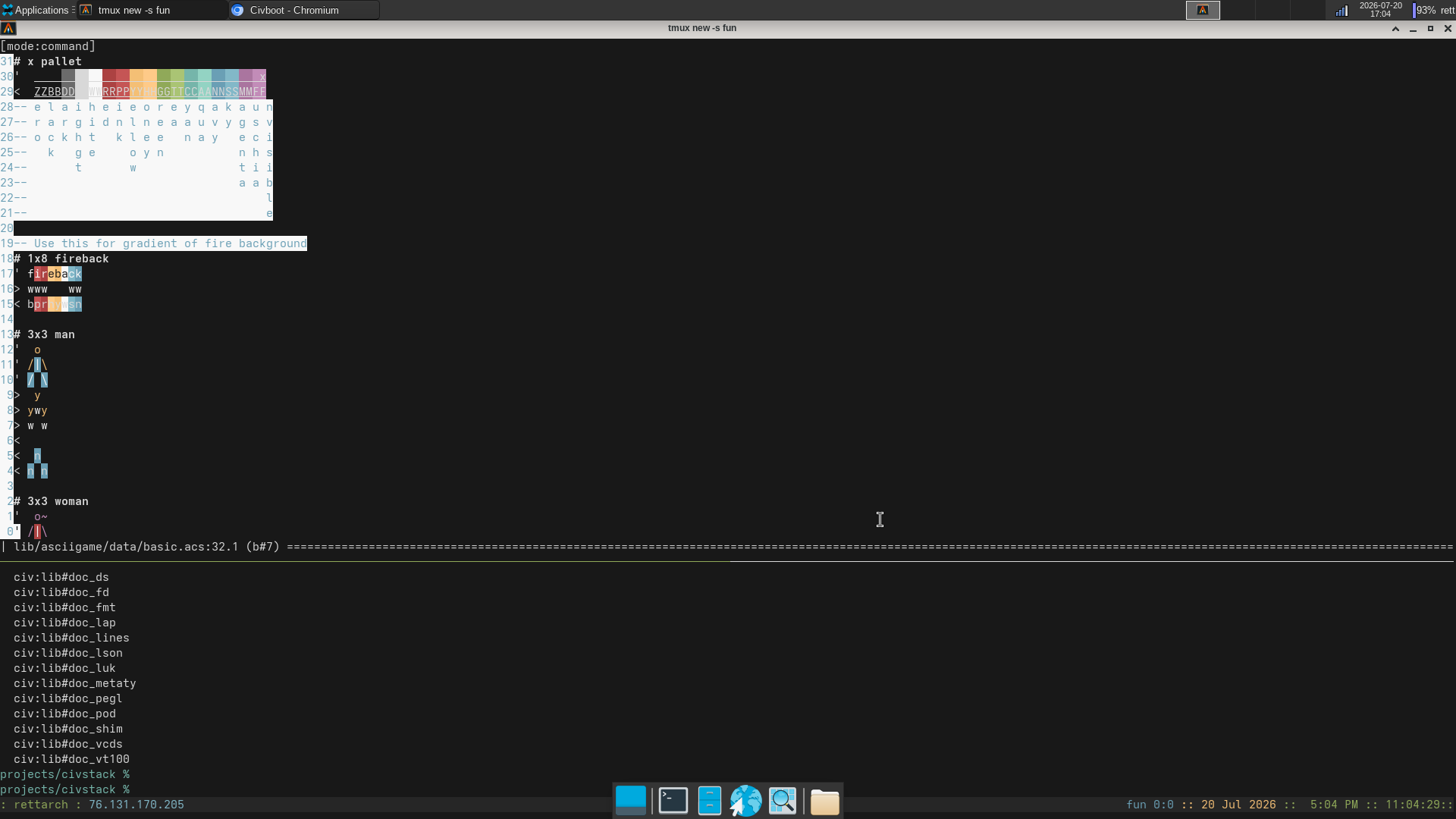
Note: right now the editor crashes if you mis-type any of the syntax... it's not really fully launched, going to fix that soon hopefully but you can see a [screenshot](https://civboot.github.io/img/asciigame.png) of what it looks like
Also, if you know any other good references for getting into asciiart I'd love to reference them as well.
Note: the Ele editor isn't _quite_ ready for all the asciiart features in your blog post, notably virtualedit and macros are not implemented yet - but I just added basic visual mode so it's getting close!
It's an interesting thought experiment / philosophy / sci fi story premise though; if he spent all those years encoding his own thought processes and decision making into a program, would he have been able to create a convincing facsimile of himself and his "consciousness"? A turing test with a chatbot based on decades of self-reflection.
Stephenson's "Fall; or, Dodge in Hell" deals with the hypothetical digitization of human minds. It has some interesting ideas like some of the synthetic minds deciding to wilfully become a hivemind
You're completely moving the goalposts. And I don't find it interesting at all (I mean, I find the general subject interesting and have delved into it for decades but I don't find this sort of casual question based on no such research, trying to connect it to the wrong thing [Cyc] at all interesting) ... would he have been able to create a convincing facsimile? If and only if the encoding method were effective--that's a tautology. Was Lenat's methodology effective to that end? No, of course not, and that wasn't its intent.
"based on decades of self-reflection"
Daniel Dennett--sadly lost to us--explained in detail why "self-reflection" is not even remotely effective to this end ... our internal processes are almost entirely inaccessible to us.


Whew, so not Ice-nine
reply